
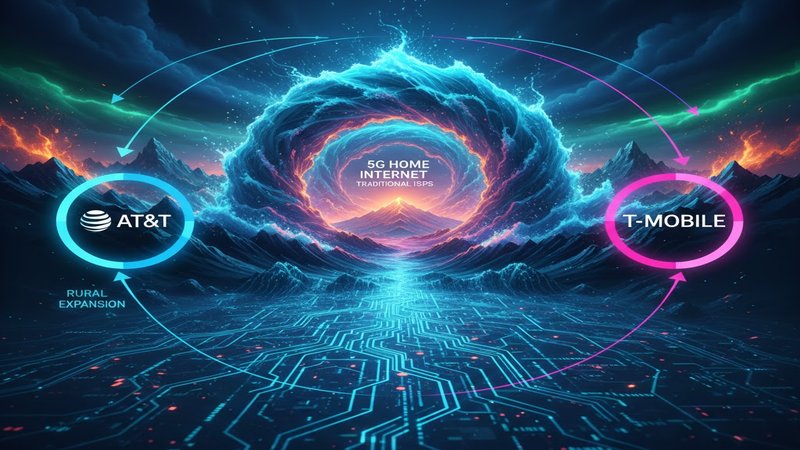
In today’s whirlwind of technological evolution, “cord cutting” has become the new vernacular, a refrain sung in the chorus of change sweeping across American living rooms. Once confined to the imagination of urban futurists, it’s now a practical reality fueled by the explosive rise of 5G home internet.
Companies like AT&T and T-Mobile are racing ahead, adding millions of subscribers, and while the broadband bouquet is offered to urban masses, it’s now reaching the forgotten corners of America — from the Sun Belt’s blazing trails to the rural patches of the Midwest.
We have to give it to these telecom giants for transforming what once seemed like a pipe dream into something as common as apple pie in the heartland. AT&T’s staggering addition of 4 million subscribers and T-Mobile’s ambitious stride past 6.2 million testifies to a burgeoning revolution. As incredible as this network renaissance sounds, switch your bandwidth and behold, it’s actually happening.
Here’s where it sets the stage for democratic access. Feel like switching but worried about the costs? Fear not! The financial horizon looks pleasantly affordable with gigabit speeds devoid of those pesky data caps. It’s an economical epiphany for households weary of overpriced and underperforming internet relics of the past.
Yet, the plot thickens. As much as we’re toasting to reduced environmental impacts — less digging and the recycling of precious labor — there lurks the challenge of spectrum congestion. This infrastructure of the air is at risk of overcrowding. The FCC, with all its policy rigor, is holding the reins, ensuring our digital freedoms don’t stumble over a tripwire set by unchecked expansion.
Through the kaleidoscope of technological supremacy, what emerges is a paradigm shift — not just a matter of wires snipped, but a rewire of lifestyle itself. It’s the dawn of Cord Cutting 2.0: a tech transition reshaping the social tapestry.
So while tech gets leaner and meaner, failsafes dangle precariously, reminding us that innovation sans contemplation is just a chaotic crescendo in the high-speed symphony. This infrastructure of the air is at risk of overcrowding. The FCC holds the reins to ensure digital freedoms don’t stumble over unchecked expansion.
The FCC’s rigorous policies on spectrum congestion underscore the need for careful consideration in expanding technology.









Leave a Reply