
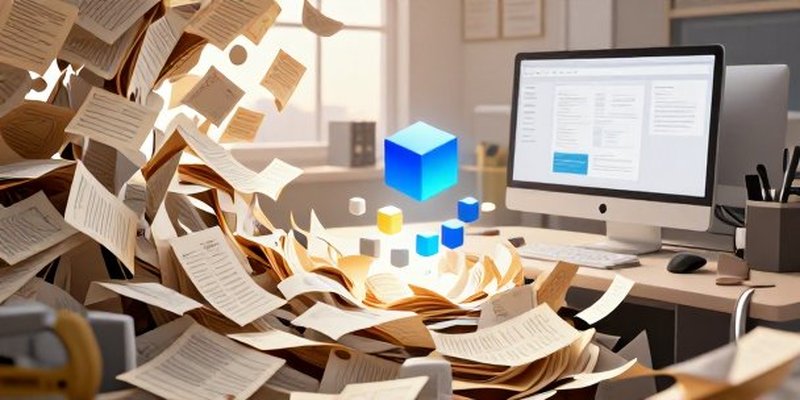
We have all been trapped in the digital salt mines, staring at a skewed, blurry PDF scan that some client sent, wishing we could magically inject it directly into our database without losing our minds. It’s the ultimate modern tax on our sanity, a tedious chore that makes me look at my ultra-efficient Ryzen 9 mini PC and wonder why we still work like it’s 1999. But the tech landscape just shifted beneath our feet with a massive, open-source breakthrough.
If you are trying to feed clean data to your AI tools without paying a king’s ransom to closed-source gatekeepers, you need to understand how this new toolkit is rewriting the rules of document intelligence.
Breaking the Document Barrier
Enter PaddleOCR, a powerhouse of a repository that’s currently sitting on over 70,000 GitHub stars for a very good reason. It’s not just a basic scanner; it’s a lightweight, battle-tested engine designed to transform chaotic real-world documents into structured Markdown or JSON.
Think of it as a tactical bridge between raw, messy images and your local Large Language Models.
While my son can ramble for hours about GPU clock speeds and VRAM without understanding a single line of backend code, this toolkit actually puts that hardware to work. It natively tackles the “five horsemen” of terrible document quality: warping, scanning artifacts, screen glare, bad lighting, and skewed angles.
Precision Under Pressure
The magic here lies in their latest PP-OCRv5 model and the PaddleOCR-VL-1.5 vision-language model. We are talking about a highly optimized 0.9-billion parameter model that punches way above its weight class, delivering a 13% accuracy boost over its predecessor. It supports over 110 languages, seamlessly handling mixed-language documents without breaking a sweat.
For a project manager trying to streamline workflows, this is the ultimate force multiplier.
The “True User” Test
In my house, technology has to pass the ultimate gatekeeper: my wife. She doesn’t care about Hugging Face integrations or dynamic resolution visual encoders; she just wants the PDF receipt parsed, the budget updated, and the Wi-Fi to stay on.
PaddleOCR bridges this gap by integrating directly with user-friendly frontends like Cherry Studio and Dify. You don’t need to be a seasoned developer to deploy it, especially with their new browser-based SDK, PaddleOCR.js. It turns a complex machine learning pipeline into a simple, binary reality: it just works.
Weaponizing Your Workflow
Stop wasting hours copy-pasting text from stubborn, locked PDFs or trying to manually format messy tables. The tools to automate this drudgery are no longer locked behind expensive corporate subscriptions.
It is time to deploy these models, feed your local AI agents clean data, and reclaim your weekends.








Leave a Reply