Big Brains, Tiny Packages: AI at Home

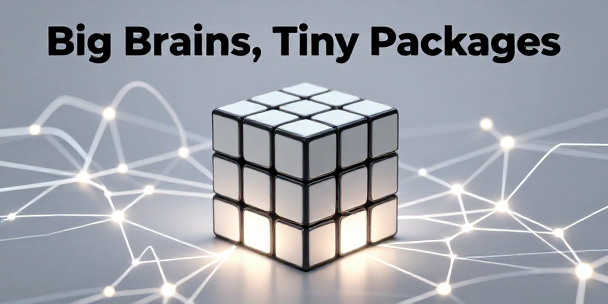
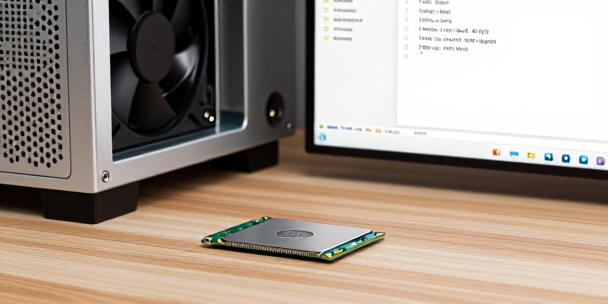
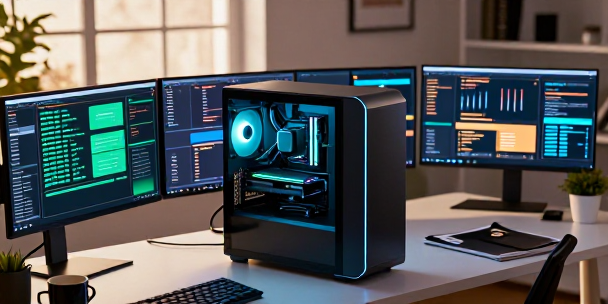
Read Time: 2.5 min.You know, sometimes I feel like I’m living in a sci-fi movie, except instead of laser battles, my daily epic is trying to keep up with the latest AI advancements. It’s like every week there’s a new, bigger, smarter model that’s supposed to change everything. Then my wife asks why the Wi-Fi is slow, and my son wants to know if the new AI can help him beat his raid boss, and I’m over here trying to remember what that article about “diversity-driven optimization” even meant. It’s a lot to juggle, trying to stay ahead of the curve while still making sure dinner gets made and the printer is actually working. Big Brains, Tiny Packages So, let’s talk about this VibeThinker project. Imagine you’ve got these massive AI models, like hulking beasts of computation, that can do incredible things, especially when it comes to reasoning and solving complex problems. They’re the reason we hear about AI writing code, acing math tests, or even coming up with scientific theories. The problem, though, is they’re huge. We’re talking about models that require more computing power than a small nation, costing a fortune to train and run. It’s like trying to use a supercomputer to play Minesweeper. My own tech setup is pretty streamlined these days – a mini PC that punches way above its weight class. It’s plenty for my project management work and dabbling in new tech. The “What If” Scenario But what if I told you that you could get a lot of that same big-brain power, that sophisticated reasoning ability, packed into a much, much smaller model? That’s essentially the question WeiboAI’s VibeThinker project is tackling. They’ve developed models, specifically VibeThinker-1.5B and VibeThinker-3B, that are designed to be incredibly efficient. We’re not talking about a slight reduction in size; these are models that are exponentially smaller than their massive counterparts. Think about it: what if you could get cutting-edge reasoning without needing a data center? Making Smart Smaller: The Secret Sauce The magic behind VibeThinker seems to lie in a pretty clever post-training methodology they call the “Spectrum-to-Signal Principle (SSP).” It’s a fancy name, but the idea is to push the boundaries of what smaller models can achieve. They’re focusing on diversity during training, exploring a wide range of solutions, and then honing in on the most accurate ones. It’s like teaching a kid by showing them all the ways to solve a math problem, good and bad, and then guiding them to the correct answer. This is super interesting because, honestly, sometimes I feel like the sheer complexity of AI development gets in its own way. This approach has apparently allowed them to achieve some pretty wild results, even outperforming much larger, established models on specific benchmarks. The Real-World Impact So, what does this mean for us? For starters, it could democratize access to powerful AI reasoning. Instead of only big tech companies or well-funded research labs being able to leverage these capabilities, smaller teams, researchers, and even developers like myself could potentially build with these more efficient, yet highly capable, models. Imagine having a personal AI assistant that can help you brainstorm complex project ideas or debug code with near-human logic, all without draining your bank account or your home’s electricity. My wife would probably just want to know if it makes her phone faster, but hey, we all have our priorities. It’s a significant shift that could change the economics and accessibility of advanced AI. The idea that you can achieve this level of performance with significantly fewer resources is frankly mind-blowing and incredibly exciting for the future of AI accessibility.




Leave a Reply