

Imagine waking up, grabbing a cup of coffee, and opening your network router logs just to discover that your own smart device is frantically screaming into the digital void every four seconds like a toddler who lost their favorite binky. You didn’t invite guests over, but a multi-billion-dollar corporation has essentially set up a squatters’ camp inside your hardware, consuming your bandwidth to talk about you behind your back. Most of us buy tech assuming that when we turn something off, it actually stops.
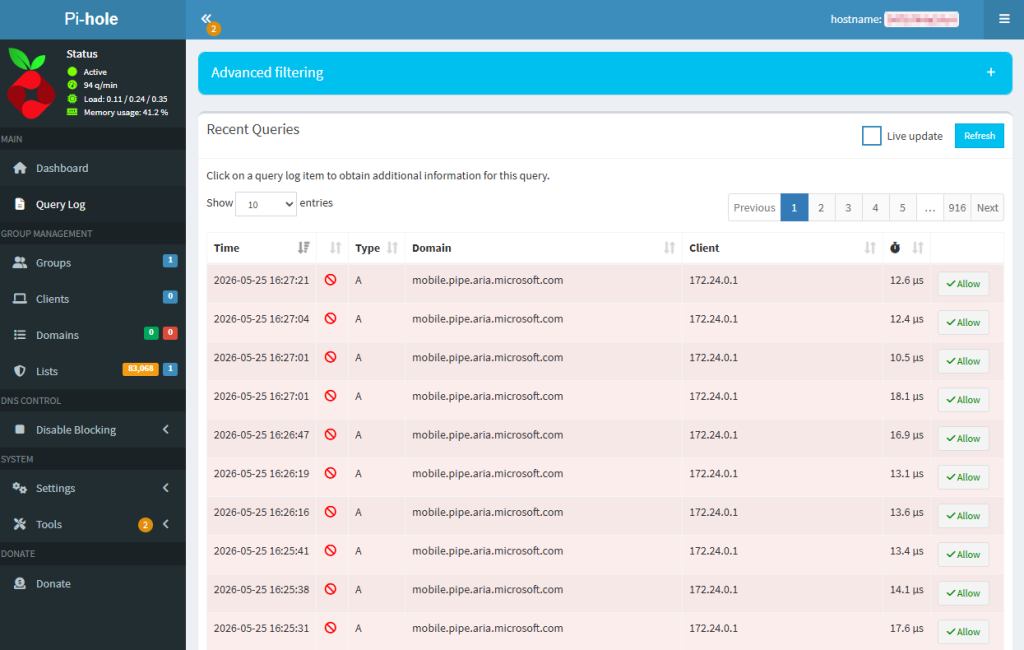
Welcome to modern software design, where your personal boundaries are treated as an engineering flaw that needs to be bypassed. If you’ve ever peeked under the hood of your home network tracker, you’ve probably seen a shady-looking domain called mobile.pipe.aria.microsoft.com completely hijacking your traffic reports. Let’s pull back the curtain on what this digital parasite is actually doing in your house.
The Corporate Stalker in Your Router
The domain in question belongs to Microsoft’s Advanced Research and Insights Architecture (ARIA). Despite having the word “mobile” slapped on it to make you think it’s just a random cell phone app, this pipeline is baked deep into almost everything they touch—Windows, Office, Edge, Teams, and gaming setups. Its entire existence is dedicated to telemetry, which is just a fancy corporate word for “gathering continuous diagnostic data, crash logs, and granular user behavior.”
It is a massive, permanent data pipeline feeding snapshots of your daily activity straight back to Redmond.
The Infinite Temper Tantrum
If you use a network-wide ad blocker or privacy tool like a Pi-hole to sever this connection, you get to witness the software’s mask completely slip. Instead of gracefully realizing it doesn’t have internet access and going to sleep, the code goes into an aggressive, hard-coded retry loop.
Because modern developers built these data pipes to be “mandatory,” the application treats your explicit privacy configuration as a temporary network error. It will shamelessly ping your gateway thousands of times a day, trying to flush its offline data queue, completely blinding your network stats out of pure corporate spite.
Feeding the AI Beast
The reality is that software is no longer a static product you purchase once on a disc and own forever. It’s a continuous, cloud-dependent surveillance ecosystem where your behavioral data is treated like oxygen.
Every menu you hover over, every shortcut you use, and every app transition creates a minute data point. With the massive corporate rush to integrate AI into every corner of your desktop, the demand for this aggregate behavioral map has skyrocketed. Your habits are the raw material they use to train the machine, and they didn’t build an off switch because they simply do not want you to have one.
What can we take from this? Let’s close this out with a reality check: you bought the hardware, you pay the internet bill, but you are absolutely not the one in control of the conversation.
Blocking these telemetry domains isn’t a tech conspiracy; it’s basic digital self-defense against a data harvest you never asked for. If you want to clean up your network dashboard, you can filter these domains out of your view or disable the telemetry services directly at the root, but the underlying greed of modern tech architecture isn’t changing anytime soon.
Drop a comment below and let me know how many thousands of times your own devices are calling home behind your back today, and share this with anyone still under the illusion that they actually own their software.











Leave a Reply