
I spent the morning staring at the newest hardware specs out of Computex, and it hit me that the traditional PC spec sheet is officially dead. For decades, upgrading my rig meant playing a predictable game of balancing CPU clock speeds against discrete GPU memory. The arrival of unified superchips like the Nvidia RTX Spark architecture completely upends that legacy baseline.
This structural break is a massive net positive for anyone running localized development environments.
The old way of throwing more wattage at isolated components has officially hit a brick wall.
Rethinking The Architecture In My House
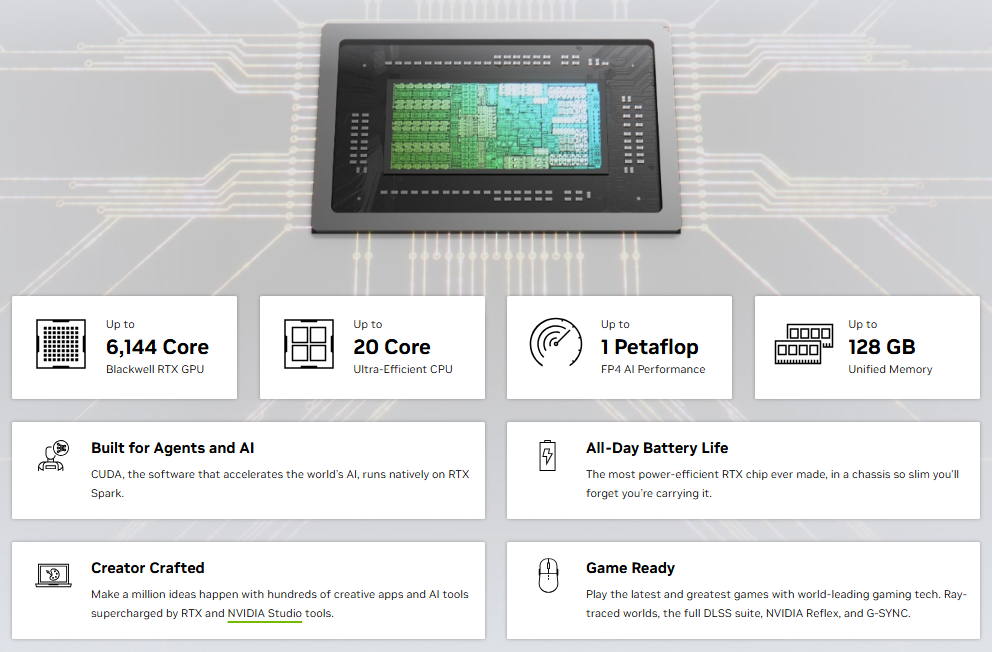
The transition to one hundred and twenty-eight gigabytes of unified memory paired with a six-thousand core GPU changes how data moves through a system. In my house, running heavy local large language models usually means fighting severe VRAM bottlenecks or watching the system lag while copying data across a PCIe bus. This new setup treats the entire system as a single, dense compute node where processing cores and tensor pipelines share the exact same pool of ultra-fast memory.
Model residency becomes a frictionless reality when you completely eliminate the traditional interconnect tax.
We are looking at the genesis of a brand new hardware lexicon.
Real Power Efficiency For My Rig
The most surprising part of this shift is watching the power requirements drop even as the core counts skyrocket. Normally, putting a twenty-core processor inside a portable chassis turns the machine into a loud, thermal nightmare that requires a massive power brick. Because this architecture adapts data center design principles down to client hardware, the system bursts energy exactly where it is needed and drops back to an idle state instantly.
My son, who usually measures system worth entirely by the FPS and raw GPU memory, even admitted this efficiency path makes sense for high-bandwidth habits.
The days of needing high power consumption to achieve high throughput are over.
The Impending Corporate Takeover
This architectural leap is a tactical land grab that could allow Nvidia to completely take over the premium market from traditional chipmakers. By fusing their own ARM-based processor designs directly into the graphics stack, they are systematically cutting legacy CPU providers out of the loop entirely. The software ecosystem is already heavily optimized for their specific tensor pipelines, making piecemeal hardware configurations look obsolete by comparison.
My wife just wants the home network to work without constant tech friction, but even casual users will notice when the premium laptop market consolidates under a single ecosystem.
Nvidia is no longer content just building the graphics cards; they want to own the entire computer.






Leave a Reply