
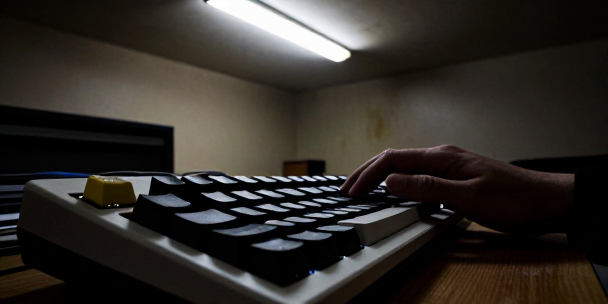
I recall back when side-channel attacks were the stuff of high-budget spy movies and DARPA whitepapers. You needed a laser microphone aimed at a third-story windowpane, a dish pointed at an office building, or thousands of dollars in custom radio equipment just to sniff the electromagnetic hum of a monitor cable. I sat at my desk this morning browsing the forums and reading through a thread on r/cybersecurity about a paper showing how AI models can listen to keyboard clatter and reconstruct typed text with up to ninety-nine percent accuracy.
Just Great, Now My Switches Are Snitches
You do not even need specialized hardware or target-specific training data to pull this off anymore. The research highlights an attack vector where unsupervised audio analysis gets paired directly with a standard AI language model. Instead of needing an attacker to manually record and label hours of your specific typing habits ahead of time, the system automatically analyzes acoustic signatures. It listens to the distinct thud of every keypress, measures micro-frequency shifts, and uses context-aware language models to infer what you wrote.
I was sitting in my office earlier testing out my clicky mechanical board during a quick local audio recording. When I ran the raw track through a simple spectrogram test, the baseline pitch differences across the key rows stood out clear as day. Every single key on a standard layout hits a slightly different frequency depending on its position on the mounting plate and how the switch housing vibrates against the board.
Noise Cancellation Is Not Saving Anyone
People online immediately jump to the defense that noise cancellation on modern VoIP calls covers everything. I hear this argument constantly whenever someone brings up audio privacy on conference calls, assuming software gates keep them safe.
My wife uses a standard wireless headset sometimesy, and half the time her soft-touch membrane keys still bleed right through the mic gate during team chats. Most built-in noise suppression algorithms filter out constant background hums like air conditioners or desk fans. Rapid, sharp transients like a mechanical switch bottoming out slip right through the filter completely because the algorithm processes them as active voice activity.
Good Luck Hiding Behind A Complex Password
The real headache comes down to how this completely guts basic security at home. You can spend weeks locking down your local network, configuring firewalls, and isolating your self-hosted setup, only to get compromised because you typed a passphrase while sitting near an active microphone.
An idling smartphone across the desk, a smart speaker sitting on a shelf, or a rogue background process on a conference call becomes an instant keylogger. Attackers do not need to drop kernel-level malware on your machine or bypass encrypted connections if they can just capture ambient room audio and let an LLM decode your credentials from sound waves.
I Guess We Are All Buying Rubber Domes Now
We have reached the point where tech enthusiasts get penalized just for preferring tactile gear. I refuse to throw away my favorite mechanical keyboard and switch to a mushy membrane board just because an algorithm learned how to decode sound waves.
Suggested countermeasures like playing recorded keystrokes in a loop to create overlapping audio noise sound like an absolute nightmare to manage while trying to focus on deep work. Maybe the only real defense left is typing with absurd, random rhythms or moving sensitive authentication entirely to physical security keys. Either way, the technology tax just keeps getting higher, and I am completely exhausted by it.







Leave a Reply